

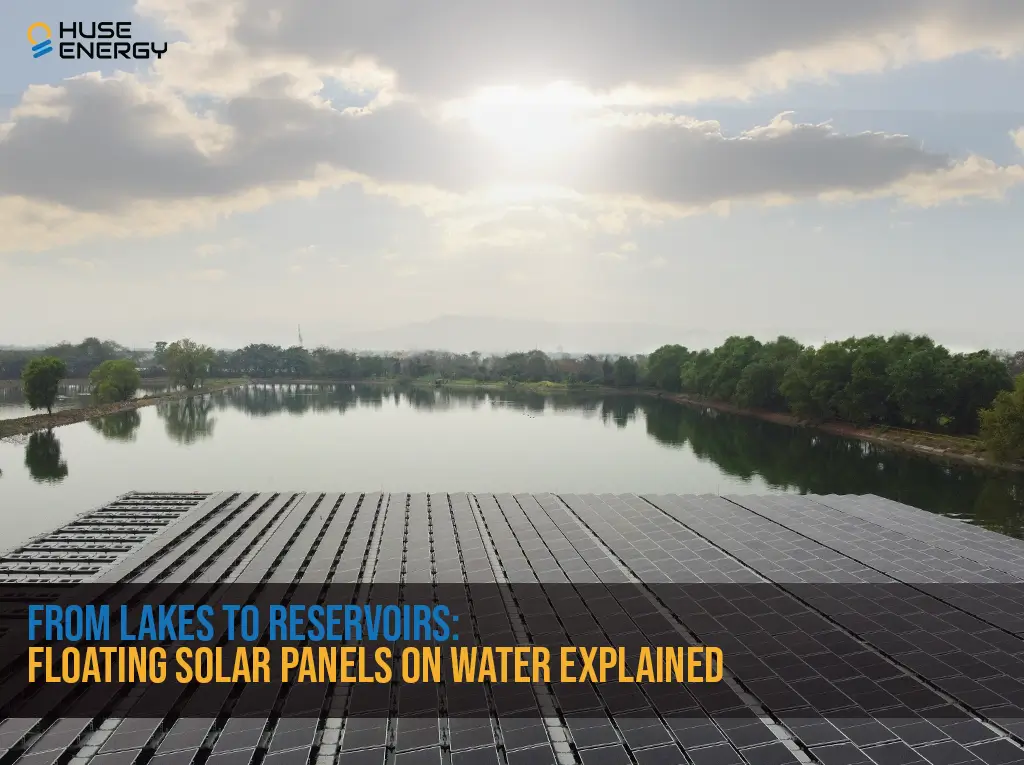
27 Dec From Lakes to Reservoirs: Floating Solar Panels on Water Explained
What would happen if the next large source of clean energy does not reside on land at all -but floats silently on lakes, and reservoirs? With water bodies in the world becoming the power centers, a new solar revolution emerges on the water- the floating panels. So, read the guide to know how floating solar panels on water are transforming renewable energy.
How Do the Floating Solar Panels Work?
The floating solar systems are constructed on the water body and then fixed as per the pre-defined location where they will be anchored. As soon as they are on the water, they are firmly anchored to prevent drift and have as much sunlight as possible.
The solar panels then receive sunlight and transform it into direct current (DC) power. The DC is then converted into alternating current (AC) by inverters, which can be used by businesses or fed into the power grid.
Why Lakes and Reservoirs Are Ideal for Floating Solar
Lakes, reservoirs and cooling ponds are well endowed with huge but unexploited water surfaces. So, it makes them ideal places to install floating solar plants in India. These controlled water bodies are used to store or manage floods. Also, the lakes and reservoirs offer sufficient space to solar arrays without interfering with agriculture, industry and urban development.
So, floating solar is an option in areas where the land is either limited or costly. It takes advantage of the same sunlight as the land-based systems. So, this is particularly efficient when high-density or land-limited locations are involved.
Components of Floating Solar Panels on Water – Understand the Structure
The floating solar panels have been constructed to be an engineering marvel, and they are designed to work well on water. Its main components are-
Floats: These offer support to the panels as well as resistance to changes in water level and adverse weather.
Mooring Systems: Anchors and flexible cables that are used to ensure that the whole structure is stable during strong winds and currents.
Electrical Components: It is equipped with high-quality wiring, inverters and transformers to facilitate conversion and transmission of energy.
Monitoring Systems: Implement sensors and intelligent software to monitor performance on a real-time basis and ensure sustainability in terms of efficiency.
The Best Benefits of Using Floating Solar Plants in India
In India, floating solar plants have become a novel alternative in India’s clean-energy landscape. Their unique placement on water bodies exposes them to benefits that can hardly be provided by conventional ground-mounted systems.
Maximal Utilization of the Limited Land Resources
India is experiencing high rates of urbanization and competing agricultural, industrial and housing land demands. So, floating solar panels on water completely remove land area requirements and use the available lakes and reservoirs. This guarantees power production without interfering with the key land-based operations or putting extra pressure on land acquisition.
Increased Efficiency by Using Natural Cooling
In operation, solar panels rely on heating thus lowering production. So, the natural cooling of water maintains lower temperatures in floating panels which enhances efficiency and overall generation of power. This performance has been found especially relevant in hot areas, where it has allowed greater dependability and uniformity in energy generation all year round.
Less Evaporation of Water and Conservation
Solar panels on reservoirs are also used to cover the surface of water, which reduces the level of evaporation significantly. This plays an important role in the agriculture and supply of drinking water in India, particularly in dry areas. Also, floating solar not only guarantees energy security but also water security because it protects the stored water.
Improved System Dynamics and Engineering
The floating systems are designed in a way that they resist the fluctuating water levels, wind loads and conditions. Such providers as Huse Energy have strong floating systems designed to be stable and high-performing.
Minimal Environmental Disruption
Solar systems do not need clearance of land, excavation of soil, or interference with natural habitats. They make use of existing water bodies with minimal ecological effects. Their modular quality makes them easy to install and remove which leaves the water ecosystems relatively undisturbed.
Conclusion About Floating Solar Panels on Water
In summary, floating solar panels on water are changing the way we use water bodies and provide clean energy. They are highly competitive, sustainable, and flexible, which makes them a strong substitute for conventional solar systems.
So, get Huse Energy’s HU-F001 Series with various kinds of floats, and AL6005-T5 floating brackets. It also offers wind resistance to 60 m/s, adjustable PV tilt of 5 0-15, and PV array layouts, ensuring future-oriented floating solar installations.