

28 May The Main Challenges and Opportunities for Floating Solar Power Plant Solutions Companies in India
Given its status as the 3rd largest energy consumer in the world, India is a crucial player when it comes to global clean energy transition.
As the climate crisis and resource shortages continue to worsen, India must take prompt action to cut down on carbon emissions and accelerate the energy transition.
solar power solutions technology is a prime renewable energy source that is enabling this transition. If harnessed efficiently, solar energy can dramatically reduce the dependence on fossil fuels and resultant carbon emissions.
Moreover, it will also bring down the energy demand gap across India, especially in remote regions where the energy supply is already limited.
In this article, we’ll explore the challenges, opportunities like floating solar power plants, and the way forward for India to lead the sustainable revolution.
What Are Floating Solar Plants in India?
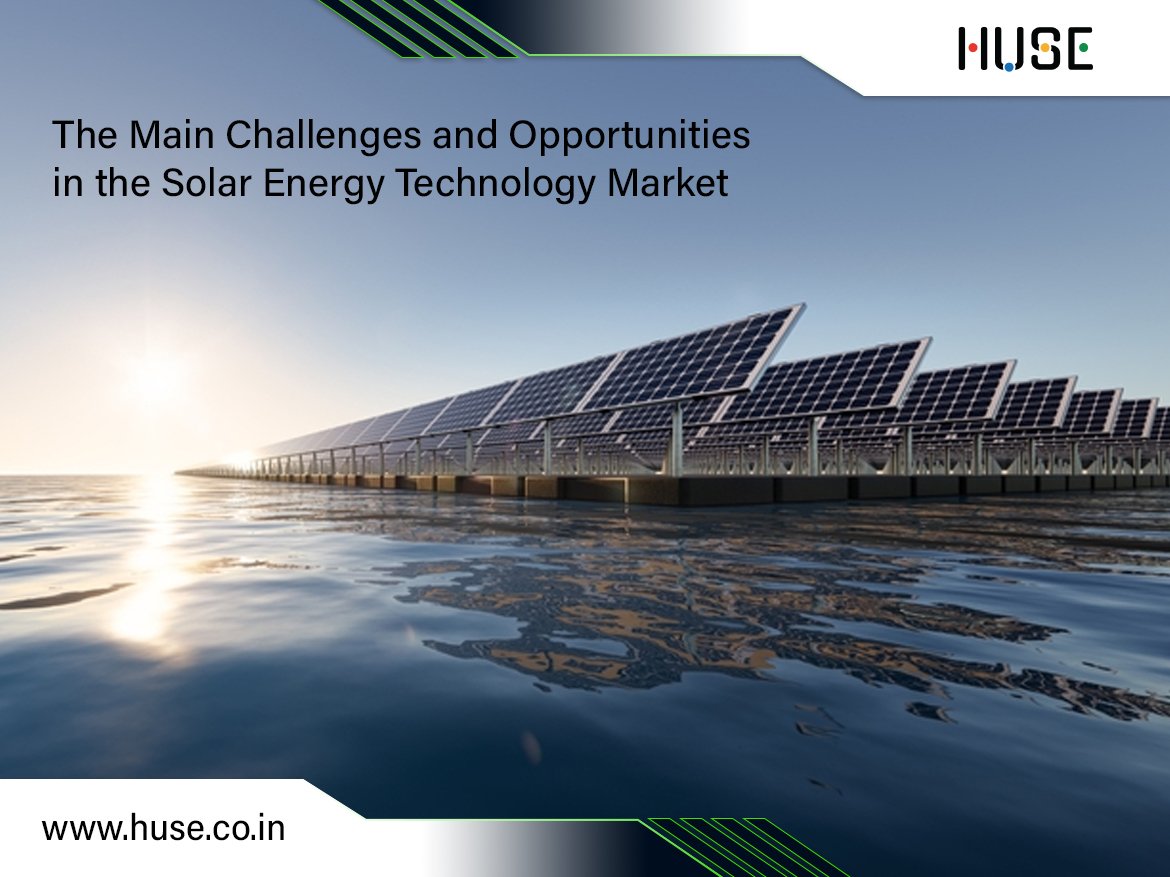
Floating solar plants in india consist of solar photovoltaic (PV) panels mounted on artificial floating structures, usually high density polyethylene (HDPE) floats, and are anchored to the bottom or banks of water bodies. The floats are mounted at a level above water to provide a platform to hold the solar PV panels and other equipment. The array is secured in place against the action of wind and waves by mooring and anchoring systems.
Floating solar plants in india are ideal for constructing solar power projects on:
– Reservoirs of hydroelectric power plants
– Irrigation and other industrial water storage tanks
– Water treatment plants and other process wastewater treatment plants
– Mining and quarrying pits
– Canals
Floating solar plants in india are especially beneficial for power utilities and other industrial and irrigation sector clients who already own large water storage facilities.
Floating Solar Systems
Our floating solar systems combine solar modules with buoyant high-density polyethylene (HDPE) structures, which are constructed to resist break-down from the sun and provide enough buoyancy and load bearing capacity to support the system.
Walkways and equipment floats are incorporated for safe access to perform operation and maintenance activities on the solar modules.
A mooring and anchoring system is used to keep the floats in position due to the effect of wind and waves.
Marine/henviour cabling is used in the electrical balance of the system along with marine transformers, inverters and other equipment to interconnect the system to the electrical grid.
Brackets and connectors are incorporated to ensure the solar modules are held at the required angle while supporting the structural load of the system.
The performance of a floating solar plant over 25 years depend on the quality of the floats as well as anchoring systems and other connections. Monsoon conditions and excessive drawdown of the reservoirs pose additional loads on the system.
Key Challenges for Floating Solar Companies in India
Although solar energy technology has a lot of positives and potential, the path to sustainability is still littered with challenges that limit scaling up. Some of these challenges include,
- Research and Development (R&D) and Manufacturing Challenges: The development of solar panels, equipment, and inverters is hampered by a lack of R&D, modern development facilities, and manufacturing infrastructure. This shortfall results in increased imports from countries like China and Germany, driving up the overall system cost.
- High Initial Investment and Long Payback Periods: Solar systems require significant upfront investment and have extended payback periods. This financial burden can divert funds from other energy sectors and increase debt, making it a less attractive option for many individuals and organizations.
- Lack of Public Awareness: One of the major obstacles to the widespread adoption of solar power solutions & energy technology is the general public’s lack of awareness. There is a pressing need to educate people, especially in rural areas, about the benefits, advantages, and accessibility of solar energy.
- Administrative Hurdles: Setting up solar generation plants is often delayed due to administrative issues such as land acquisition, government approvals, and material supply limitations. This can be mitigated by establishing dedicated government bodies focused on facilitating solar energy implementation.
- Limited Support and Warranty Concerns: Many companies’ limited support and warranty for solar panels and system installations pose significant concerns for customers. Ensuring comprehensive support and extended warranties would alleviate some of these worries and encourage more adoption.
- Limited manufacturing capabilities: among Floating Solar Companies in India for floating structures.
- Lack of India-specific design codes for floating solar projects.
- Environmental assessments are required to evaluate the impact of floating structures on water-body ecosystems.
- Engineering complexity in designing anchoring systems for reservoirs with significant seasonal water-level fluctuations.
- Experienced floater manufacturers and EPC teams add value through tested products, proven installation methods, and project expertise.
Opportunities for Floating Solar Companies in India
India, being one of the largest consumers of energy, imports about 85% of its energy,which leads to high expenses.
However, with around 300 sunny days annually, India has the potential to harness solar energy, which could significantly reduce this dependency. The solar energy incidence on India’s land area is approximately five quadrillion kilowatt-hours per year, surpassing the country’s total fossil fuel reserves.
Many states have already identified the vast potential of solar power solutions & Solar energy technology. In the future, solar power is expected to meet substantial energy demands across sectors like electricity, automobiles, manufacturing, and commerce. Capturing a small fraction of this energy could power the entire country.
Here are some opportunities that can help us reach this milestone:
- Policy Support for Domestic Manufacturing: Government initiatives like the Production Linked Incentive (PLI) scheme aim to boost domestic solar manufacturing, creating opportunities for local production.
- Cost Reduction: The rapid decrease in solar equipment costs, combined with policies that encourage competitive bidding and market-driven tariffs, paves the way for affordable renewable energy generation.
- Off-Grid and Rooftop Solar: Policies promoting off-grid and rooftop solar installations help decentralize energy generation and address energy access challenges.
- Technology Innovation: Encouraging policies for research, development, and innovation in solar technologies players like floating solar companies in India can enhance efficiency and cost-effectiveness, driving further advancements in the sector.
Why Are Floating Solar Power Plants in India Increasing?
Many power utilities of Floating Solar Power Plants in India have solar power projects in their plans and are currently looking to add more capacity. Floating solar power projects offer a number of benefits over ground mounted solar power projects.
1.First, land is a constrained and costly resource in India. Solar power projects require significant land area, and utility owned water bodies provide a means to construct solar power projects without the need to acquire additional land.
2.Also, solar power projects experience a reduction in power generation due to increase in panel temperature. The water body provides natural cooling to the solar panels, thereby improving the overall power generation.
- Decreased Water Evaporation
Floating Solar Power Plants in India have the added benefit of reducing water evaporation. Many studies on floating solar power plants in India and abroad have shown a drop in evaporation by up to 70%, and have been known to benefit reservoirs that are located in drier, more arid regions.
- Beneficial to Hydropower
Most of the larger Floating Solar Power Plants in India, developed by NHPC and SJVN, have been constructed on top of hydropower plants. Like a conventional power plant, a floater solar power plant has the added benefit of reducing CO2 emissions during peak hours. Since both solar and hydro-power are complementary to each other, the cost of grid inter-connection is reduced.
- Pro-Active Solar Policies
The PM-KUSUM scheme (2026) has an outlay of 5070 crores, and has set an ambitious target of developing 5 GW of floating solar plants, along with 10,000 MWh of battery storage by 2030. The center also offers financial assistance of 1 crore rupees per MW of floating solar capacity, and up to 50 lakhs for feasibility studies.
The scheme is expected to catalyze the development of solar power projects in states like Maharashtra, Madhya Pradesh, Karnataka, Odisha and Telangana, which currently have the largest solar potential. India has an 120 GW target by 2030, and with floating solar projects expected to account for a large portion of new solar capacity, it is expected that the country will meet its targets.
Floating Solar Power Plants in India: Notable Projects
| Project | Location | Capacity | Notes |
|---|---|---|---|
| Omkareshwar Floating Solar Park | Khandwa, Madhya Pradesh | 600 MW | Developed on the Omkareshwar Dam reservoir by Rewa Ultra Mega Solar, AMP Energy, NHDC, and SJVN |
| NTPC Ramagundam | Telangana | 100 MW | One of India’s largest single-site floating solar installations, spread across ~500 acres of water |
| NTPC Haripad (Kayamkulam) | Alappuzha, Kerala | 92 MW | Built across NTPC’s Rajiv Gandhi Combined Cycle Power Plant reservoirs, commissioned in phases through 2022 |
| NHPC Odisha | Odisha | 500 MW (planned) | ₹2,000+ crore initial phase, developed on reservoir assets in partnership with the state |
These projects illustrate a clear trend: floating solar power plants in India are moving from pilot-scale (a few MW) to genuinely grid-scale infrastructure, and the demand for reliable floaters, mooring systems, and EPC execution is scaling with it.
How to Select Floating Solar Companies in India
Selecting the right floating solar company in India would mean looking for the following:
Design and float construction experience: Adequate testing of float construction for various elements such as winds, buoyancy and strength.
Local float construction: A Floater design and construction has to be integrated to be efficient. Outsourcing reduces the level of integration.
EPC Capability: Ability to take up the complete project from start to finish.
Engineering capability for different water conditions: A company should be able to address different anchoring requirements for different water conditions.
R&D for engineering: Companies which undertake wind and wave load case studies and design for such conditions would reduce the need for field maintenance.
Huse Energy has significant R&D efforts for engineering floating solar systems. The company’s floaters are designed to withstand winds of up to 220 km/h and are backed with patented ultrasonic sealing and a bolted joint system.
Our core strength is designing and executing EPC projects. We support clients in various segments (developers, utilities and industries) in Floating Solar Companies in India. Our end-to-end solution comprises feasibility studies, detailed design, procurement, construction, and commissioning of floating solar PV power plants.
Floating Solar Power Plant: The Way Forward
Considering the many challenges, such as limited resource availability, rising demand for power, distribution difficulties in rural areas, and increasing fuel prices, India is fast shifting towards solar energy technology to source its energy requirements.
In fact, India is the fifth-largest country in the world in terms of solar power deployment. If we take advantage of opportunities like floating solar plants , rooftop solar, and more, solar energy technology can supply India’s entire energy needs.
We at Huse Live are on a mission to offer cost-effective, sustainable, renewable energy solutions through our state-of-the-art floating solar technology.
We are one of the leading floating solar companies in India. We are wholeheartedly dedicated to minimizing the environmental impact of fossil fuel-based energy consumption and championing sustainability.
Reduce your carbon footprint today with our floating solar plants in india. Contact us to learn more.
The floating solar PV projects potential in India is huge. With the recent focus of the Central Government on developing floating solar PV projects, through the initiatives launched by the Hon’ble Prime Minister, project developers can expect several policy and regulatory support in implementing such projects. Several pilot projects have already been commissioned. Huse Energy possesses the knowledge and experience in delivering complete floating solar solutions, spanning from engineering to construction.
FAQs on Floating Solar Power Plant Solutions & Floating Solar Companies in India
How efficient is a floating solar plants in india?
A floating solar plants in india is an efficient way of consuming sustainable and renewable energy because the water cools the panels, helping them maintain their temperature and operate at higher efficiency. Additionally, this energy distribution and consumption setup reduces water evaporation and algal blooms. HUSE is one of the leading floating solar companies in India, advancing floating solar technology with its innovative projects to generate clean energy and contribute to India’s renewable and sustainable energy goals.
What floating solar power plants in india are available in India?
India offers various floating solar power plants in india to meet its energy needs. Ground-mounted solar farms are one of the most utilized approaches, using vast farms to install a series of solar panels. Rooftop solar solutions provide decentralized energy generation for residential and industrial purposes. A floating solar power plants in india is yet another approach that uses water bodies for the cooling effect, which helps the panels operate more efficiently. Additionally, solar thermal power plants utilize sunlight to heat fluids in order to generate electricity. These are some notable energy solutions that help India progress towards its renewable energy targets.
What is the main agenda of floating solar companies in india?
The main agenda of floating solar companies in India is to maximize the country’s renewable energy generation by utilizing water bodies for solar energy generation. Experts install these solar panels on water bodies to maximize land use efficiently and contribute to the country’s sustainability goals. Furthermore, floating solar plants in india also help to reduce water evaporation and improve the system efficiency due to the cooling effect of water below the panel. By implementing this floating solar power plants in india, the focus is to develop innovative and cost-effective floating solar solutions to support India’s transition towards green energy.
What are the challenges of floating solar plants in india?
A floating solar plants in india faces several challenges, including high installation costs and the need for specialized infrastructure. The aquatic environment can create issues with maintenance and accessibility, especially during extreme weather events. Additionally, the potential impact on local ecosystems and water quality must be carefully evaluated. Managing the cooling effect of water on solar panels can also be complex. Despite these challenges, innovations in floating solar plants in india are paving the way for more efficient and sustainable floating installations.
How efficient is a floating solar power plant?
A floating solar power plants in india can achieve efficiencies comparable to traditional solar installations, often around 15%. Water's cooling effect enhances panel performance, particularly in hot climates. Additionally, water's reflective nature can increase solar capture, improving overall output. However, efficiency may vary based on factors such as location, panel type, and design. As advancements in floating solar power plants in india continue, floating systems are becoming increasingly effective, making them a viable alternative to land-based solar farms.
What are the environmental benefits of floating solar companies in india?
floating solar companies in india offer significant environmental benefits, including reduced greenhouse gas emissions and a lower carbon footprint compared to fossil fuels. They help decrease air pollution, contributing to cleaner air and improving public health. Solar energy also reduces water consumption, as it requires minimal water for operation compared to traditional power generation methods. Additionally, integrating floating solar power plants can prevent water evaporation and improve local ecosystems, enhancing biodiversity. Overall, floating solar companies in india contribute to a more sustainable future.
What are floating solar plants in india?
A floating solar power plant is a solar power plant which is built on a body of water (reservoir, pond, etc.), as opposed to being constructed on land or on a roof. Floating solar power plants are composed of solar PV modules which are mounted on floats. Each float is anchored to the body of water to prevent it from drifting or being moved by waves.
How do floating solar plants in india?
Floats made of High Density Polyethylene (HDPE) are connected to form an array to hold the solar modules. Each array is moored to the bottom of the reservoir. Each mooring system is specifically designed for the body of water which it is anchored to. Similar to land based solar power plants, the power generated is transmitted to inverters which are connected to the grid or a captive power system.
Which is the largest floating solar power plants in india?
The Omkareshwar Floating Solar Power Park in Madhya Pradesh is spread over 500 acres and has a capacity of 600 MW. The NTPC plant in Telangana is spread over 500 acres and has a capacity of 100 MW.
What are the advantages of floating solar plants in India compared to placing solar panels on land?
Floating solar plants eliminate the need for land acquisition and negotiation with competing land use. Floating solar plants located over water bodies can provide electricity with water cooling and help reduce evaporation in water bodies.
What is the aim of the government of India in the field of floating solar plants in India?
The Union Cabinet, in July 2022, approved the setting up of 5 GW floating solar and associated battery storage projects over a period of 5 years starting from 2022-23. The estimated cost for this project would be around INR 50,700 crore. The total estimated potential for floating solar in India is around 102 GW.
What is the price difference between a floating solar plants in indiaand a ground-mounted solar plant?
floating solar plants in india have higher initial costs compared to ground-mounted solar power plants due to the added costs of floating structures and electrical infrastructure. Costs related to land and permits can be reduced for solar power plants compared to other forms of power plants. Combined with the efficiency increase from water cooling, the levelized cost of energy for a floating solar power plant can be lower than ground-mounted solar power plants.
What kinds of businesses and agencies in India employ floating solar energy?
Public sector power and hydropower generating companies (NTPC, NHPC and SJVN), State Renewable Energy Development Agencies, industrial concerns with captive ETPs and ponds, irrigation and other municipal departments engage in floating solar for power generation.
What impacts do floating solar companies in india have on ecosystems?
Floating solar projects typically leave a significant portion of a body of water open, and are assessed from an environmental impact perspective prior to being built. Shading from a floating solar array can limit evaporation and the growth of algae, but if the array is anchored too heavily and is covering a large area, it can adversely effect other ecosystems.
What differentiates Huse Energy from other floating solar companies in india
Huse Energy has their floaters manufactured by them and is and EPC company. Huse Energy also has wind floaters (rated to 60 m/s) and anti-shedding connections patents.