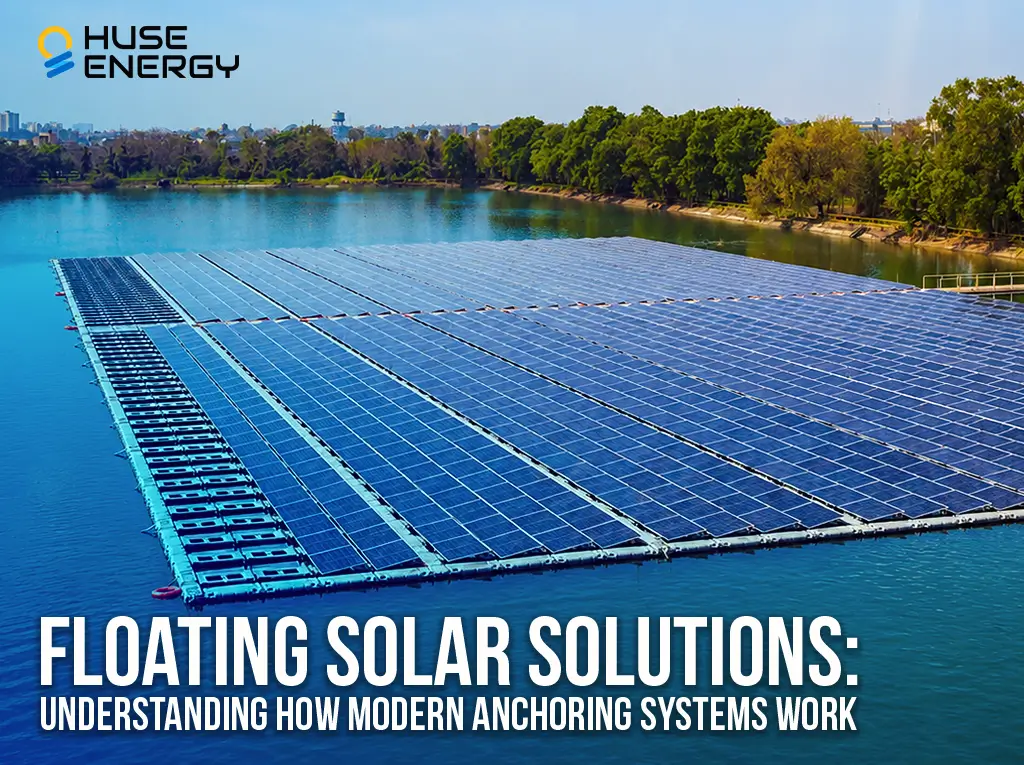
Modern energy infrastructure is moving towards the construction of facilities using water, which makes the use of land more effective and increases the stability of energy production. In the course of such development, floating solar solutions are being widely used at reservoirs and lakes to produce solar energy.
The operation of such facilities requires an anchoring system that ensures accurate location under any environmental conditions. Therefore, this guarantees stable energy production from renewable sources.
Importance of Anchoring in Floating Solar Solution
Anchoring systems are necessary to provide proper balancing and positioning of floating solar systems in water bodies. They help in providing stability during operation despite any changes in environmental factors.
● Structural Positioning Stability System of Floating Solar Solution
An anchoring system ensures that the floating structure is fixed in its position regardless of the varying circumstances. This avoids the floating structure from drifting due to wind action and waves. Thus, proper solar alignment is maintained to generate power.
● Environmental Stress Resistance Mechanism
These systems are able to cope with wind force, water current, and changing environmental forces in floating structures. Additionally, they minimize structural strain on parts due to the even distribution of loads. This ensures that resilience and efficiency are increased in the projects designed by leading companies like Huse Energy.
● Load Distribution Engineering Function
Anchoring guarantees uniform loading on floating structures during the operation cycle. This helps to ensure that there is no local stress or imbalance. Therefore, this leads to stability for effective system functioning in contemporary applications.
● Water Level Adaptation Capability
Floating technology adjusts well with respect to seasonal changes in water levels. Anchoring provides flexibility in movement without having any effect on structure and production capacity. This guarantees sustained operation in the application environment of floating solar solutions.
● Solar Alignment Optimization Support
Anchoring ensures that solar panels always face the sun properly during the working cycles. Moreover, it prevents misalignment from occurring due to the movement of water and other forces. It increases the efficiency of energy production through floatovoltaics.
Factors Engineers Consider When Designing Anchoring Systems
The engineers will factor in the environmental conditions, the strength of the materials used, and the stress exerted by the structure before designing the anchoring system. In turn, they will ensure that the operation of such structures within water-based solar power plants becomes reliable and stable. This is particularly necessary when handling large floating solar panels.
● Hydrodynamic Force Evaluation Study
Engineers look at the movement patterns of water and wave power to ascertain environmental dynamics first. This will help determine the strength needed for the anchor. This is instrumental in determining the strength required for anchoring. Therefore, stability is guaranteed under consistent hydrodynamic pressure and variable water conditions.
● Material Durability Selection Process
Engineers always use materials that do not easily corrode or weaken when immersed in water. This helps to ensure durability despite continuous exposure to water and environmental conditions. Consequently, there is a need for minimal maintenance and a longer lifespan of systems.
● Wind Load Structural Assessment
The pressure caused by the wind is analyzed in order to prevent any structural movement during inclement weather. Appropriate design allows the structure to withstand high-speed winds without compromising its stability. This significantly enhances both operation and structural safety.
● Site Condition Engineering Analysis
Engineers analyze water depths, surface movements, and environmental changes prior to designing the system. This helps achieve a customized anchoring system at each site. Thus, there is a marked improvement in installation precision and system efficiency.
● Load Balance Structural Design Method
The loading pattern is such that there is no stress concentration at particular structural points. In this way, an even distribution of forces is achieved for the whole floating structure while in use. Thus, structural stability is ensured in the long run.
Benefits of Strong Anchoring in Floating Solar Solutions
Effective anchoring systems can greatly improve performance, longevity, and sustainability in all types of water body conditions of floating solar projects. This is because they provide stability in variable weather and water body conditions. Also, effectiveness is achieved through the utilization of efficient anchoring systems in floating solar solutions.
● Environmental Stability Enhancement System
Effective anchoring helps to align the structure correctly regardless of any changes in water levels or other environmental factors. This prevents any drift or misalignment of panels during normal use. Consequently, energy production remains constant regardless of the climatic conditions.
● Operational Reliability Improvement System
The secure anchoring ensures proper functioning of the floating platform at all times of the day. Moreover, anchoring prevents the dangers that arise from waves, wind, and other movements on the surface of the water. It enhances efficiency and steady energy production performance.
● Structural Durability Enhancement Benefit
Efficient anchoring ensures that mechanical strain is minimized on floating structures due to the continuous movement of water. Therefore, it increases the longevity of such structures while minimizing the need for future maintenance. This makes it an efficient investment venture when installing solar energy systems employing floating PV panels.
● Safety and Protection Support System
Anchoring properly reduces the chances of structural damage when there are storms, strong winds, and extreme water conditions. This guarantees that the floats are safely positioned at all times during their working periods. Consequently, this improves the security of the entire system.
● Energy Efficiency Stability Improvement
It is crucial in ensuring that the panels are optimally oriented to capture as much sun as possible at any point during the day. Therefore, it helps to avoid any losses associated with displacement or any other misalignment. It improves efficiency in energy use and production.
Why Choose Huse Energy for Modern Anchoring Systems for Floating Solar Solutions?
Reliable floating solar solutions have to start with good anchoring systems. They stabilize panels, adjust to water levels, withstand environmental forces and ensure optimal solar alignment. This makes them safer, more durable and more energy efficient, and makes sure that they continue to generate renewable power in all water and weather conditions.
With evolving renewable technologies, Huse Energy has become instrumental in providing engineering services for floating solar arrays. Our comprehensive experience in EPC, along with our fabrication skills, ensures optimal functionality of today’s energy installations.
FAQs
Where can the Floating Solar System be set up?
A floating solar system can be set up in a reservoir, lake, irrigation pond, quarry lake, etc. Many industrial and utility companies use a floating solar solution for renewable energy production without requiring any land area.
Which sectors can profit from energy floating solar panels?
Sectors such as the agricultural sector, water management, manufacturing industries, mining industries, utility companies, and governmental facilities can benefit from Energy Floating Solar Panels. In addition, floating PV panels are extensively utilized in reservoirs and industries for producing renewable energy without occupying much land area.
What is floating solar energy?
This is an energy technology that uses photovoltaic panels mounted on floating platforms that are placed on water surfaces for the generation of energy from the sun. Generated energy is channeled into inverters and the electrical grid using cables.
What range of capacities are available for energy floating solar panels?
Ans: Energy floating solar panels exist in different ranges of capacities, starting from kilowatts to multi-megawatts, among others. There are numerous factors that influence the capacity of such panels, including the size of water surfaces available, among others.
Are floating solar power plants applicable for remote or off-grid areas?
Floating solar power plants have the capability of addressing the energy needs of remote and off-grid areas with limited land and limited access to energy supply. Also, floating PV panels will work well even with batteries.