

27 Feb Water level variations & drought: how do floating solar panels on water meet the challenge?
If you’ve been following the renewable energy scene in India lately, you know that solar is no longer just about mounting blue plates on a tin roof. We’ve moved to the water. But whenever we talk to people about floating solar panels on water, the first question isn’t about efficiency or cost. It’s usually: “What happens when the water dries up?”
It’s a valid fear. India is a land of extremes. One month, we’re dealing with monsoons that fill our reservoirs to the brim, and a few months later, we’re staring at cracked, dry ground because of a heatwave. For any of the floating solar companies in India, this isn’t just a theoretical problem; it’s the reality of engineering for the Indian landscape.
If a floating plant can’t handle a 10-meter drop in water level or a complete drought, it’s not a solution; it’s a liability. Let’s look at how this technology stands up to the challenge when the environment gets tough.
The Anchoring Secret Behind Floating Solar Panels on Water: It’s Not Just About Floating
Most people focus on the “floating” part, but in the world of floating solar power plants in India, the “anchoring” is what does the heavy lifting. Think of it like a boat in a harbour. If the tide goes down and your rope is too short, the boat flips. If the rope is too long without a tension system, the boat drifts into the rocks.
When we design systems at Huse Energy, we spend a massive amount of time on “Bathymetry”, which is basically a fancy word for mapping the floor of the water body. You must know the deepest point and the shallowest point.
To handle water level variations, we use specialised mooring lines (usually high-strength synthetic ropes or heavy-duty chains) combined with weights on the bottom. As the water level rises, the floats move up, and the mooring system adjusts the tension. When the water level drops, the system “gives” enough slack, so the panels stay level. It’s a constant, silent dance between the equipment and the water.
The Nightmare Scenario: What Happens to Floating Solar Panels on Water During a Total Drought?
This is the “make or break” moment. In many parts of Maharashtra or Gujarat, reservoirs are designed to be emptied for irrigation. When the water disappears, the floating solar plant must “bottom out.”
A poorly designed system will crack under its own weight when it hits the uneven floor of a dried-up pond. This is why the material of the floaters matters so much. High-quality systems use HDPE (High-Density Polyethene), which has a bit of “flex.”
At Huse Energy, our engineering team ensures that the connection points between the floats aren’t rigid. They need to behave like a spine flexible enough to rest on a slightly rocky or sloping reservoir floor without snapping. When the rain returns and the water level rises, the plant simply lifts off the ground and starts floating again. No harm done.
Why India is the Ultimate Testing Ground for Floating Solar Panels on Water
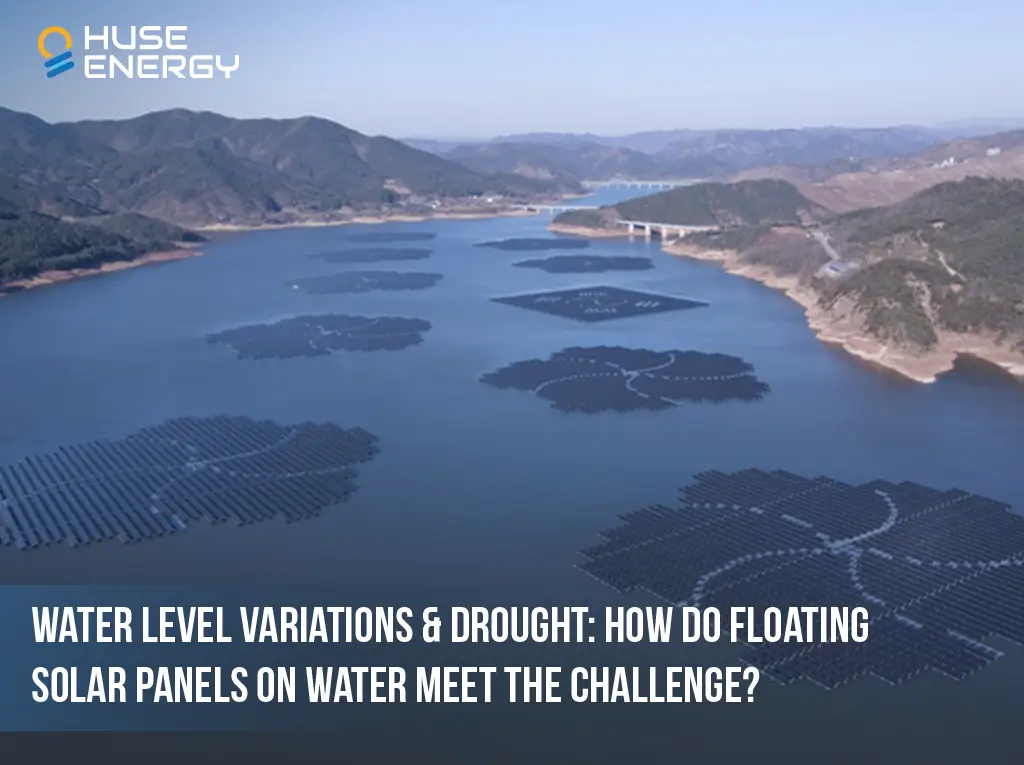
India is currently home to some of the largest floating solar power plants in India, like the ones in Ramagundam or Omkareshwar. Why? Because we have a massive land-scarcity problem. We can’t just keep covering farmland with mirrors.
But our water bodies are “working” water bodies. They aren’t just sitting there for aesthetics; they are used for hydroelectric power, drinking water, and farming. This means the water level is always changing.
Floating solar companies in India have had to become world leaders in “flexible engineering” because our conditions are so much harsher than in Europe or Japan. We deal with high silt levels, massive evaporation rates, and drastic seasonal shifts.
The Unintended Benefit of Floating Solar Panels on Water: Fighting the Drought Itself
Here is the logical “win-win” that many people miss. Floating solar panels on water help prevent the very drought that threatens them.
How? By shading the water. In a country like ours, evaporation loss in open reservoirs is staggering. When you cover a significant portion of a lake with solar panels, you’re essentially putting a lid on it. You block the direct sunlight and lower the water temperature. This significantly reduces evaporation.
So, while the system is designed to survive a drought, its very presence ensures that the water lasts a few weeks longer than it would have otherwise. For a farmer relying on that reservoir, those extra weeks are everything.
Choosing the Right Partner for the Long Haul: Expertise in Floating Solar Panels on Water
If you’re a business owner or a government official looking at FSPV (Floating Solar Photovoltaic), you shouldn’t be asking “Is it cheap?” You should be asking, “Has this system been tested for 60m/s wind loads and 10-meter level shifts?”
This is where Huse Energy steps in. We don’t just import floaters and hope for the best. Being part of the Sujan Industries family, we have decades of experience in industrial manufacturing. We understand how materials fatigue under stress. Our R&D focuses on the “worst-case scenario.”
We look at:
- Stress Distribution: Making sure the weight of the panels doesn’t crush the floats when they hit the ground.
- Environmental Resilience: Ensuring the plastic doesn’t become brittle after five years of intense Indian sun.
- Smart Anchoring: Systems that don’t require manual adjustment every time the season changes.
Conclusion:
Floating solar isn’t a “fair-weather” technology. It’s built for the messiness of nature. Yes, the water will go down. Yes, there will be years when the reservoir looks like a desert. But with the right engineering and a focus on specialised anchoring, these plants can sit through the dry spell and power back up the second the first raindrop hits.
India’s transition to green energy depends on us using every square meter of space we have, including the water. And at Huse Energy, we’re making sure that “water level” is just a number on a gauge, not a threat to our energy future.