

23 Sep High-Stability Floaters for Floating Solar Walkways- Enabling Safer and Easier Operations and Maintenance
High-Stability Floaters for Floating Solar Walkways- Enabling Safer and Easier Operations and Maintenance
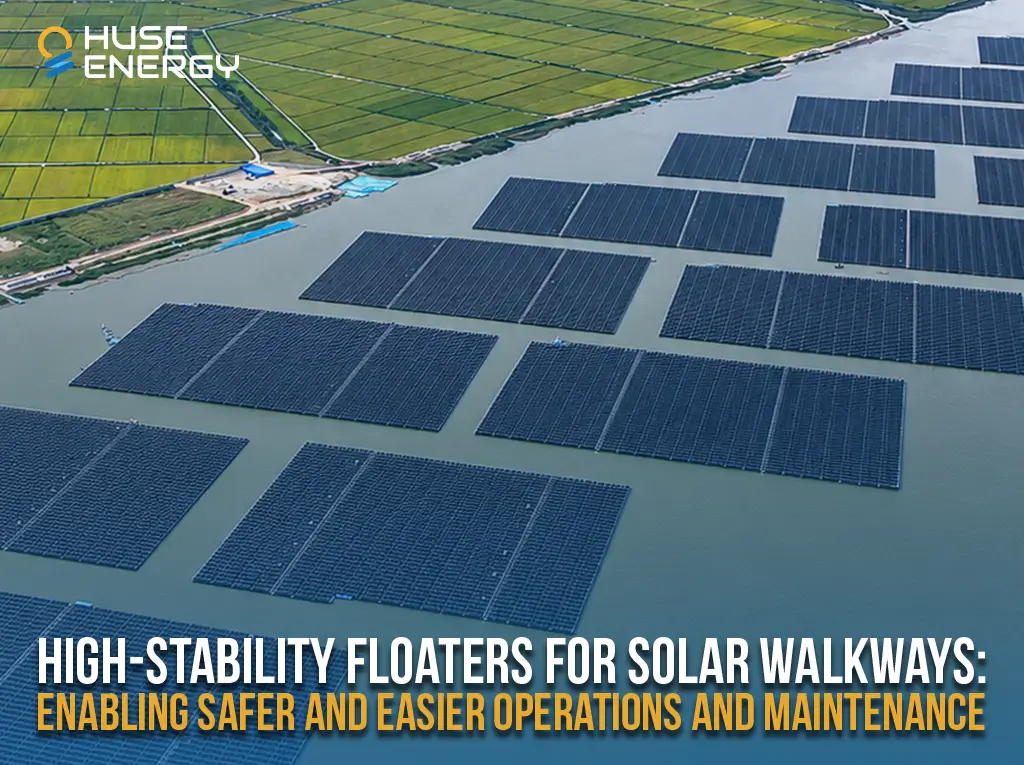
A floating solar plant only performs well if it has a strong base support to hold it up. Weak floaters and shaky access paths make routine maintenance slow and risky for technicians on site. A stronger base changes how a plant gets designed, inspected, and kept running for decades. Therefore, installing the high-stability floaters is the starting point, not a finishing touch that you may think to add later.
Why High-Stability Floaters Are the Backbone of Floating Solar Walkways
A floater carries the full weight of solar modules, technicians, and mounting hardware without tilting. It also resists wind loads and constant wave motion across years of outdoor exposure on open water.
That combination of load and weather resistance is exactly what these platforms are engineered for. A design that survives one dry summer but fails in the next monsoon offers little real value for floating solar power plants in India.
A 2026 report from India’s National Institute of Solar Energy assessed the country’s floating solar potential at over 102 gigawatts. That scale of opportunity is enormous, but only if the high-stability floaters underneath can actually carry it safely.
Floating Solar Walkways – Designed for Safer Access
Panels are fragile and costly, so fixed floating solar walkways for technicians protect both people and equipment during routine visits. Nobody should have to step across live modules just to reach a junction box.
A stable walkway system turns inspection into a simple task instead of a slow, careful balancing act. That difference matters most during storms, low light, or emergency checks after heavy rain.
What Does Modular Floating Walkways Include
Modular floating walkways come up with a few core components and some safety accessories. Here is what a well-built walkway system usually includes.
- Walkways separate foot traffic from module surfaces, cutting down accidental panel damage
- Integrated walkway floats connect directly into the main structure for a fixed path
- Textured, slip-resistant surfaces reduce fall risk even when floats stay wet
- Wider sections with handrails and guardrails that let two technicians pass safely during larger repair jobs
Some sites rely on dedicated floating solar walkway floaters that snap onto the grid only where access is actually needed. Larger installations sometimes go further with fully modular floating walkways planned around the layout from day one.
Floating Solar Components That Keep the System Stable
A floating array depends on many small parts working together. Weakness in one area speeds up wear everywhere else across the grid, so nothing here works in isolation. The floating solar components below play a specific structural role in that shared workload.
Floating Solar Components List
- Main floating body provides primary buoyancy and holds the module mounting brackets firmly in place
- Equipment floating body supports inverters, junction boxes, and other electrical hardware above water level
- HDPE connectors and gaskets link individual floats together and seal every joint against water
- Anchoring truss and mooring lines hold the structure steady against shifting water currents
- Anti-shedding bolts and nuts keep floats locked together even under repeated wave movement
A properly sized floating solar mounting system keeps every panel at the correct tilt angle while resisting wind uplift.
Floating Solar Platforms Built for Indian Water Bodies
India has a wide variety of water bodies that do not behave in the same way. So, floating solar platforms cannot rely on a single fixed design across every site. Shallow irrigation ponds remain calm for most of the year, whereas larger reservoirs must contend with harsh winds and currents.
This variation is considered during the planning stage, and appropriate changes to spacing of floats, anchorage depth, and thickness of materials are made before installation begins. This groundwork is what keeps a platform steady long after the initial monsoon testing ends.
Floating Solar O&M – Why Stability Makes Maintenance Easier
Stability changes how a plant gets maintained over its full working life, not just during installation. Industry guidance from IEA-PVPS points to floater and connector failure as a leading cause of downtime on floating arrays.
Floating solar O&M Stability Benefits
Routine inspection becomes far less demanding once the base itself stops moving unpredictably. Choosing carefully among floating solar companies in India at the design stage often decides how smooth this maintenance experience turns out to be years down the line.
- Stable floaters lower the chance of module misalignment, which protects long-term output
- Secure connectors reduce leaks and cracks that would otherwise demand urgent repair
- Walkable platforms cut down the need for boats or divers during routine checks
- Lower structural stress helps keep annual costs near two to five percent of capital cost
Fewer emergency repairs also let maintenance teams plan visits ahead of time, which makes floating solar O&M budgets far easier to predict year over year for site owners.
Read More –Floating solar project india how it works why it matters
Why Choose Huse Energy for Purchasing High-Stability Floaters
Serious floating solar projects across Indian reservoirs cannot afford weak foundations anymore. Owners need platforms built for the long term, and floater quality has become a first-order decision for most developers. Therefore, a project’s entire safety record often traces back to this one early choice that you make when installing high-stability floaters.
Huse Energy manufactures its floaters and tests each one against real wind, wave, and load conditions rather than lab assumptions alone. We design floaters to be flexible with different conditions on the site rather than applying a single template for each case. We combine the manufacture of floaters with the full EPC service, offering our experience in the implementation of floating solar energy technology at any reservoir in the country.
FAQs on floating solar pv system
What are high-stability floaters used in floating solar plants?
These are floating solar platforms that hold solar panels and walkways over open water without leaning under the action of wind and waves. This is the basis of the entire floating system.
How does a floating solar walkway ensure technician safety?
It ensures safe and secure pathway across the floating system. The technicians will not have to walk on solar panels themselves; hence, there is no risk of falling off or breaking them.
What are the elements of floating solar platforms?
There are several parts to a floating solar platform; main floating units, equipment floats, HDPE connectors, anchoring trusses, mooring lines, and anti-shedding bolts. All parts equally share loads and maintain alignment.
Why does floating solar O&M cost less than ground-mounted O&M?
Maintenance costs can be lower in floating panels because water cooling of the panels minimizes contamination and increases the efficiency of the system.
Why should I choose Huse Energy for floating solar floaters?
Huse Energy tests its floating solar floaters under the most extreme wind and load conditions and provides full EPC services. This makes us a dependable partner for large-scale work.